
What bac water is, why peptides are mixed with it, and how to read the lab report that should come with it. We walk through a real, publicly verifiable report line by line, so you know what a passing result looks like and what to question.
Bacteriostatic water is sterile water with 0.9% benzyl alcohol added as a preservative. The benzyl alcohol is the whole point. It slows the growth of bacteria that might get into the vial, which is what makes it acceptable to puncture the same stopper many times.
"Bacteriostatic" literally means it stops bacteria from multiplying. It does not mean it kills them, and it does not make a contaminated vial safe. That distinction matters later when we get to how long to keep it.
Most peptides are sold as a freeze-dried powder and have to be dissolved before use. That process is called reconstitution. Once the powder is in solution you usually draw from the vial more than once, over days or weeks. A plain water vial that gets punctured repeatedly has nothing working against contamination. Bac water does, which is why it is the standard choice for vials you will go back into.
How much to add is a separate decision, and it controls how your dose reads on the syringe. The Reconstitution Guide picks a volume for you, and the Syringe & Needle Guide explains why that choice matters.
| Liquid | What is in it | Typical use |
|---|---|---|
| Bacteriostatic water | Sterile water + 0.9% benzyl alcohol | Multi-use vials. The preservative allows repeated draws. |
| Sterile water | Sterile water, no preservative | Single use. Once opened there is nothing to hold bacteria back, so it is meant to be used once and discarded. |
| Bacteriostatic saline | 0.9% sodium chloride + benzyl alcohol | Used by some people in place of water. Water is the common default for freeze-dried peptides, and the better choice can depend on the specific peptide. |
Because bac water is only useful if it is actually sterile and actually contains the right amount of preservative, a legitimate batch should have a Certificate of Analysis (COA), a lab report showing what was tested and what the results were. A vial with no report is a vial you are taking on faith.
What a bac water COA is checking: that the preservative is present at the right strength, that the pH is in range, that nothing grew in a sterility test, and that bacterial endotoxins are low.
Below is a report for a batch of bac water, shown here with permission to use it as a teaching example. It was run by an independent lab and is publicly available. You can pull it up on the lab's own site to confirm it is genuine.
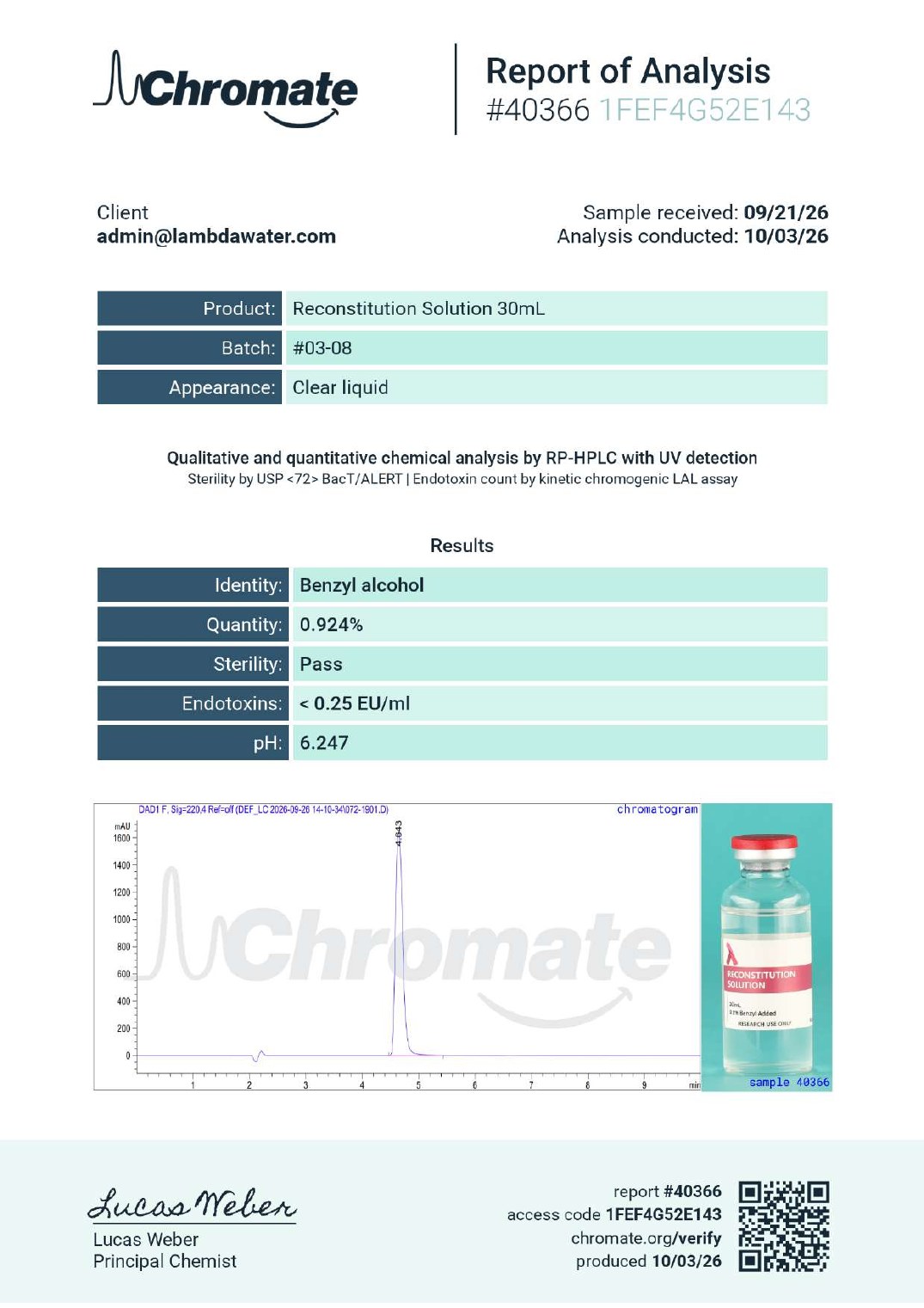
Here is what each part of it means and what a passing result looks like.
The lab identified the preservative in the liquid. For bac water this should be benzyl alcohol.
How much benzyl alcohol is in the vial. Standard bac water is labeled at 0.9%, and USP bacteriostatic water is also sold at 1.1%. A result close to the label claim is what you want. Far below it means weak preservation, and far above it means something was mixed wrong.
Bacteriostatic water for injection is held to a pH between 4.5 and 7.0, and this batch lands comfortably inside it. pH matters because it affects both comfort at the injection site and how stable some peptides are once dissolved.
A sample was incubated to see whether anything grew. Pass means nothing did. This is the most important line on the page, and there is no partial credit.
Endotoxins are fragments from the walls of dead bacteria. They can cause a fever-like reaction even in a liquid that is technically sterile. Results are reported as "less than" a limit, and injectable water standards are commonly cited at about 0.5 EU/ml, so a result under that is the goal.
It is a simple check, and it is also the one you can repeat yourself at home. More on that below.
A few honest limits, because a report with all passing numbers can still be over-read.
Bac water should always be clear. If it looks cloudy, hazy, or has anything floating in it, throw it out. That applies at any age, whether it was opened yesterday or has never been opened.
You will usually see 28 days quoted as the limit once a vial has been punctured. That figure comes from the standard that hospitals and pharmacies follow for multi-dose vials. It is a deliberately conservative default for settings where many people share supplies and nobody can afford a mistake. It is not a tested point at which the water suddenly goes bad.
In practice, hospitals tend to follow it and most individuals do not. Many people keep a vial longer, and some report using theirs for up to 60 days.
This is information, not medical advice, and it is your call. Keeping a vial past the standard window is a choice, and the risk that comes with it is yours.
What drives that risk is contamination, not the calendar. Benzyl alcohol slows bacterial growth but does not sterilize, so every puncture is a chance to introduce something. Fewer punctures, wiping the stopper with alcohol each time, and a fresh needle each time all matter more than the day count.
The cloudy rule is the one place we would not treat as optional. It costs you nothing to check and it is a clear sign something has gone wrong.
Get bac water that comes with a report you can verify, check that the batch matches your vial, and look for the four results that matter: preservative near 0.9%, pH between 4.5 and 7.0, sterility pass, and low endotoxins. After that, how you handle the vial is what keeps it good.
Next, work out how much to add with the Reconstitution Guide, or see what your dose looks like on a syringe with the Dosage Calculator.